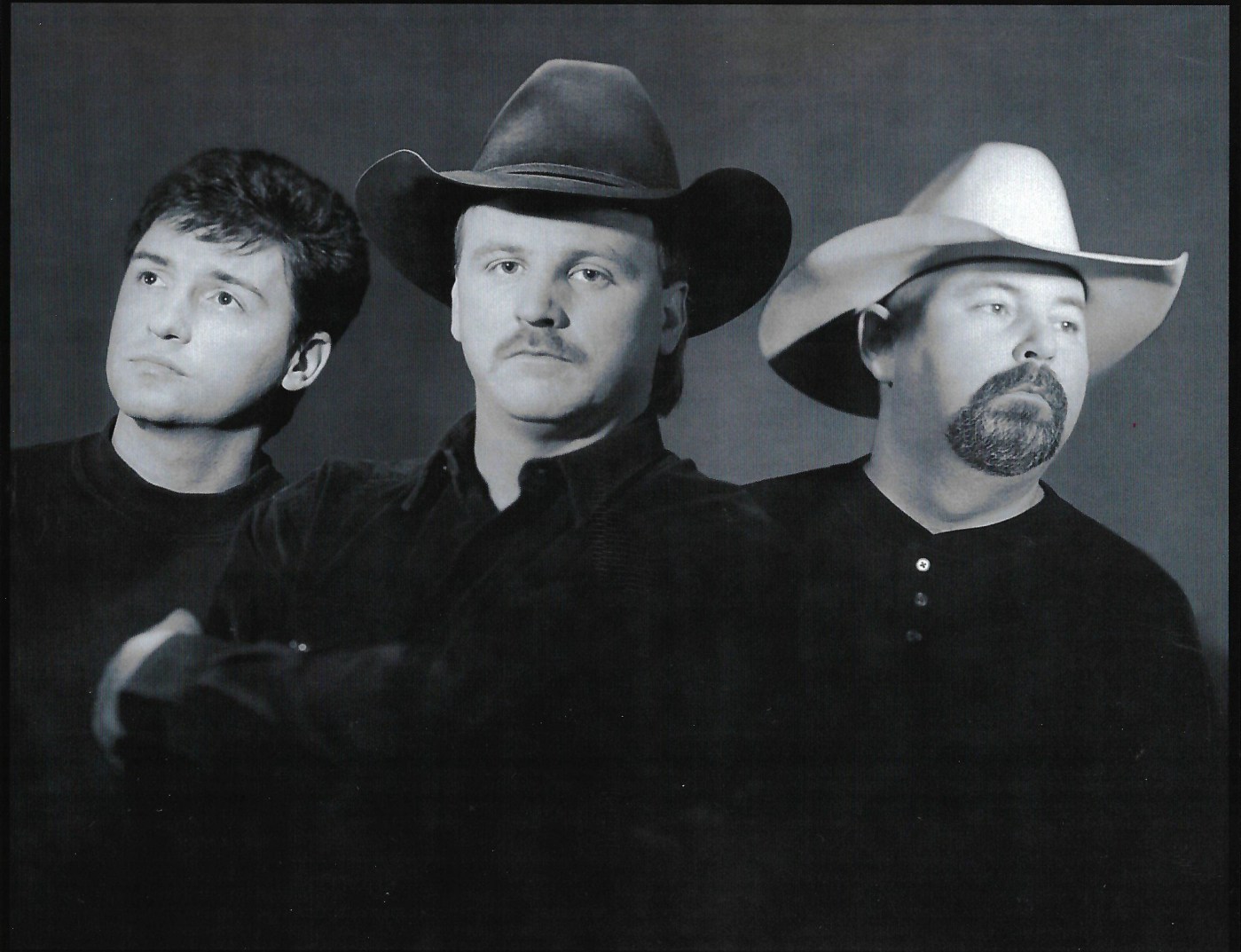
Thirty years after bursting onto the country music scene, there’s no silencing Perfect Stranger.
From the highs of conquering the independent scene in Texas, signing a record deal and scoring a top-five hit to the lows of struggling on the charts, disbanding and the tragic loss of a founding member, Perfect Stranger has endured, as has their smash hit, “You Have the Right to Remain Silent,” which has brought the band back together to celebrate its three decades of success, with new shows and new music on the horizon.
Before all of that, though, the story of Perfect Stranger begins with rival bands in a small, east Texas town.
“I had a band called Midnight Express,” says bassist and co-founder Shayne Morrison. “Richard [Raines] had a band called Destiny. In our little town of Carthage, Texas, we were rival bands. Any time there was a battle of the bands, it was always Midnight Express versus Destiny.”
By that time, Morrison had been cutting his chops on the bass for many years, and began forging a path towards doing it for a living.
“I was playing guitar first, but I would always play basslines on it. I talked my mom and dad into picking me up a little old bass, and I started playing along to old country records,” says Morrison. “When I was about 16 years-old, there were a few guys in my hometown that had a band and played the VFWs. I went and played with them, and I actually got paid! Once I had a little money, I realized you could do something you loved and get paid for it. From then on, that’s what I was doing.”
By the mid-80s, Morrison and Raines decided to team up to form a new band, and in Morrison’s parents’ living room, they landed on a new name: Perfect Stranger.
“Naming a band isn’t as easy as it sounds. It’s like naming animals; it’s really hard,” Morrison says with a laugh. “There was a band back in the 80s called Southern Pacific, and they had a song called ‘Perfect Stranger.’ That’s how we named the band.”
After meeting vocalist Steve Murray in 1992, the nucleus of the band was set, and they began playing covers in Texas clubs.
“Our go to with cover songs was Gary Stewart. We played every Gary Stewart song there was. He was the epitome of country and honky tonk music,” says Morrison. “We played Billy Bob’s a lot, which is the king of honky tonks in Texas. It’s got two stages: the front stage where the cover bands play during the week, and the big back stage. We always played the front stage, just dreaming of playing the stage in the back one day.”
With countless hours of stage time under their belts, the band eventually caught the ear of someone who offered to help them take their next step.
“We were a bunch of east Texas guys that couldn’t rub two nickels together, but those shows got us in front of enough people to where one day, a guy came up to us and offered to pay for us to record an album,” says Morrison. “That’s how we ended up in Nashville. We picked the songs and hired a producer. We did the album independently and put it out in Texas.”
As they entered the studio to record that album, It’s Up to You, they were struck by the talent of Nashville’s A-list studio musicians.
“It was very intimidating. We’d been in a few studios and recorded a few demos, but we’d never been in Nashville. It was the four of us, but we had to bring in some players on steel, fiddle and piano,” says Morrison. “Bobby Wood played piano on it, and he also came up with the piano part on ‘The Dance.’ You’re playing with guys you’re totally intimidated by, which took some getting used to. Of course, they weren’t trying to be intimidating, but for us, it was cool to have people that played on songs that people would know forever playing on our songs, too.”
When the album was finished, the band released “Ridin’ the Rodeo,” a Vince Gill-penned song, as its lead single, and soon watched it become one of the top independent country songs in America.
“We were huge Vince Gill fans, so it was awesome to cut one of his songs,” says Morrison. “We recorded a video for the song at the same club in Tulsa, Oklahoma that Brooks & Dunn recorded the ‘Boot Scootin’ Boogie’ video. We watched the song go up the charts. We sold tens of thousands of records in Houston alone.”
Those impressive sales on their independent release sparked the interest of Curb Records, who licensed the album, renaming it You Have the Right to Remain Silent, a song featured on It’s Up to You that had been pitched to them at Billy Bob’s.
“We were playing the front stage at the same time they were shooting the George Strait movie, Pure Country, down the road,” says Morrison. “George’s acoustic player said he had a song that we needed to hear. It was ‘You Have the Right to Remain Silent.’”
Curb Records released the song as the first single from the re-branded album. Though the song would eventually climb its way to number four on the country charts, initially, the band didn’t realize they had a special hit on their hands.
“We were picking out songs and listened to it on the bus,” says Morrison. “We thought, for a ballad, it was one of the better ones we had. We cut it and we didn’t really think a lot of it. We didn’t think that would be the song that would put us on the map, but it took off.”
As the song made its way up the charts, the band soon learned that label politics would stop their hit in its tracks.
“We were visiting a radio station in Minneapolis, talking to the program director and thanking him for playing our song, and the phone rang. The program director saw it was Curb Records, and he answered it while we were sitting there. One of Curb’s promoters called, not knowing we were there, and asked the station to stop playing ‘You Have the Right to Remain Silent’ and to increase the spins on the Jo Dee Messina song at the time,” says Morrison. “We thought that was weird, because we thought they were going to make a big push to make it go number one. Jeff Carson had ‘The Car’ out at the time, and he ended up going number one. I loved Jeff, and I was proud for him to get it.”
Though it didn’t top the charts, the song allowed the band to fulfill a dream they’d spawned years earlier on the front stage at Billy Bob’s.
“One day in the mid-90s, after years and years of being on that little stage up front, because of that song, we got to play the back stage,” says Morrison. “We were a ten-year, overnight sensation.”
The following year, the band realized a new dream when they were nominated for Top New Vocal Group at the 1996 ACM Awards.
“That was a total surprise. We were up against Lonestar and a group called 4Runner. Lonestar had ‘No News’ out, which blew up, and elevated them above us,” says Morrison. “But to be nominated, to sit in that crowd and to be on TV was an unreal experience for four dudes from east Texas. It was amazing to be there.”
Three more singles, ballads “I’m a Stranger Here Myself” and “Remember the Ride,” and the rowdy “Cut Me Off” followed the Band’s breakthrough smash, each failing to reach the top 50. When the time came to record their follow up album, The Hits, the band felt pressure to deliver.
“We knew if we didn’t perform with that record, we weren’t going to have a record deal anymore,” says Morrison. “The pressure was on.”
Three singles were released prior to The Hits’, including the Vince Gill-penned, non-album single “Coming Up Short Again,” which was followed by two more ballads, “The Hits” and “Miracle,” after the album’s release, both of which failed to chart.
“’The Hits’ might be my favorite song we ever cut,” says Morrison. “We knew it was over after that song didn’t work, because if you had asked us which song was going to be the ‘Right to Remain Silent’ on that album, it would’ve been that one. But by then, I think people were tired of ballads in G from Perfect Stranger.”
The album title may have also caused some confusion.
“People were wondering why we had a greatest hits album after we only had one hit,” Morrison says with a laugh. “Hindsight is 20/20, but it was a strange album title.”
Less than a decade after “You Have the Right to Remain Silent” took over the airwaves, Perfect Stranger and Curb Records parted ways.
“It took a year or two after The Hits for us to finally agree to disagree with them,” says Morrison. “By that time, you’re automatically seen as a washed up, one-hit wonder, and it’s hard to come back from that.”
The Band tried to soldier on, but they, too, soon went their separate ways.
“We kept playing and we cut more music, but we had a hard time finding out how to get the music out,” says Morrison. “We played until we thought it was time to take a little break, and then we went and did our own things.”
Morrison never left the music business while the band was dormant, but he did add a notch to his resumé outside of music.
“I had a duo act called Morrison-Williams, and we did an independent record. I played with Billy Joe Shaver for a while, and then I played with Trent Willmon, who is one of my favorite singer/songwriters of all time. I also did some producing for Josh Ward and Jon Wolfe,” says Morrison. “Believe it or not, I went to the Police Academy when I was 45. For 15 years, instead of singing the Miranda Rights, I’ve been reading them to people [laughs]. I’ve been a crime detective in a town just south of Fort Worth for the last 12 years.”
Save for a brief reunion in 2010, Perfect Stranger didn’t play together again until reuniting in 2025 for the 30thanniversary of “You Have the Right to Remain Silent.” In doing so, they’re performing without guitarist Richard Raines, who tragically passed away in 2013.
“Richard was a larger than life personality. He was Robin Williams. When we’d do interviews or go to radio stations, Richard was the one that people wanted to talk to. He was also one of the most creative guitar players. Every time he’d play something, we’d think ‘where did he come up with that?’ He meant the world to the band, and we’re never going to forget him or let people forget that he was a major part of our band” says Morrison. “I’ve learned over the years that some of the funniest people have some darkness. The humor is helping to mask something. I was friends with Richard since 5th grade. Over the years, he’d swing through moods and I had no idea where it came from. In 2013, I’d just started one of my early police jobs. I got the call from a drummer that had played with us for a while. I was devastated.”
As Murray and Morrison keep Raines’ memory alive on stage, they instantly found their old chemistry.
“It was like riding a bicycle,” says Morrison. “We never struggled a bit.”
The chemistry was so strong, in fact, that the band has entered the studio and are working on a new EP.
“It’d been 15 years since we’ve played together. 90s music is so big right now. People want to go back to songs that have depth, meaning, fiddle and steel,” says Morrison. “We just cut six new songs. We’re not sure what we’re going to do with them yet, but we have different avenues to release them. We want to get it out there and stir up the ‘Right to Remain Silent’ crowd again.”
For three decades, that crowd has never faded, as the song has earned millions of streams and still sees countless covers from musicians on the internet.
“We may have only had one hit, but it was a good one,” says Morrison. “I try to watch everybody that picks up a guitar and sings the song or does a karaoke version on YouTube. It makes me smile to know that people think enough of the song to want to play it. It doesn’t matter if it’s the best singer in the world or someone singing it not even close to the key the song is in. It’s all awesome.”
As 2025 comes to a close, the Band plans to finish their new EP, hit the road and build on their three-decade legacy.
“For a minute there, we were a household name. People knew our song and band. We toured the world, and it’s all because of that one song. It changed our lives,” says Morrison. “It’s nice that now, there’s no pressure whatsoever. It’s just Steve and I having fun. When it’s in your blood like this, it’s hard to get rid of.”
 Pro Country
Leave a comment